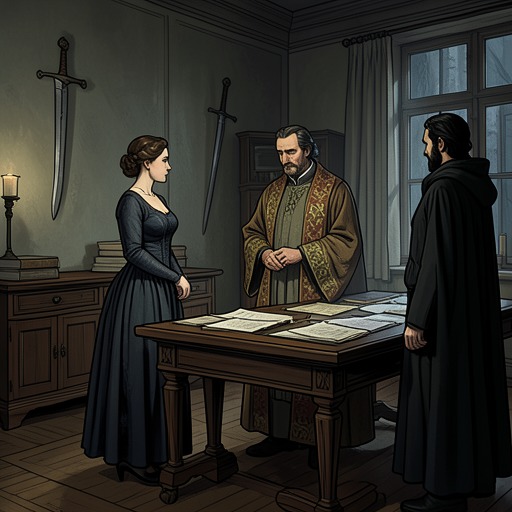
Trial by combat of Jean de Carrouges and Jacques Le Gris
The Last DuelThe Trial by combat of Jean de Carrouges and Jacques Le Gris was both a legal appeal and a public test of competing oaths. Authorized by the Parlement of Paris in a case resting on uncorroborated testimony, it placed the lives of the two men—and Marguerite de Carrouges’s life—under the judgment of combat. Its elaborate royal and religious ceremonies made the proceeding appear to submit the dispute to God, while its eventual place in legal history was stark: it was the last judicial duel sanctioned by the Parlement.
Background and authorization
In medieval French law, a nobleman appealing a case to the king could challenge his opponent to judicial combat. This was not simply a private duel over an insult: it was a formal legal procedure intended to establish which party had sworn falsely. The combat was understood as a judgment of God, with victory taken to disclose the truth through divine will. In a criminal case, the principals ordinarily had to fight in person; a champion could substitute only for a woman, an elderly person, or someone infirm.
The procedure had become increasingly unusual. Popes condemned judicial combat as an improper appeal to God, while kings opposed it in part because it limited their control over justice. Louis IX removed it from French civil law in 1258, and Philip IV outlawed it in war and then in peacetime. After nobles objected, Philip restored it in 1306 as an appeal in certain criminal cases, including rape, but only under the king’s direct jurisdiction. That history made the Parlement’s decision consequential: no rape case had received its authorization for a duel since 1354, and it had rejected appeals for combat in 1330, 1341, 1342, 1343, 1372, 1377, and 1383.
The court nevertheless ordered Jean de Carrouges and Jacques Le Gris to fight. The case had divided people at court and in Paris, with supporters on both sides. The court may have been wary of openly siding with either man, particularly while Charles VI and his uncles were away in Flanders. By authorizing the combat, it granted Jean’s appeal while leaving the ultimate verdict, in the logic of the procedure, to God. The date was set for November 27, 1386, at least forty days after the order; Charles later postponed the combat for a month so he could attend after returning from Flanders.
The field and its audience
The combat was to take place at the Saint-Martin-des-Champs Priory, whose grounds included a field built for such encounters and large enough to accommodate thousands. Preparations distinguished among spectators by status. Most were commoners from Paris and its suburbs, who would watch from the ground or through gaps in the high timber fencing. The prominent stands were divided among the king and leading nobles, members of the royal court, foreign nobles seated according to rank, and, in separate stands, women. Lower-ranking spectators, including burghers and merchants, occupied places further down this social arrangement.
The strict organization of the venue reflected the court’s effort to control both the combat and the public response to it. Guards were to keep spectators from the inner fence and prevent disturbances. A herald announced that those without official duties or royal permission could not carry weapons, and that spectators must remain seated and refrain from speaking, gesturing, or otherwise disrupting the battle. Even an outburst could bring severe penalties. The crowd was not meant to behave as at a noisy entertainment: its enforced silence made the duel a supervised legal and political spectacle.
Ceremony and unequal stakes
Charles VI was more than the most important spectator. As the king in whose name the Parlement had authorized the duel, he was also its presiding judge. The combat could not begin until he arrived and took his seat. The royal procession included officials responsible for the ceremony and weapons, heralds, guards, and a sword of justice carried before the king. In this setting, royal authority framed an ordeal represented as divine judgment.
Jean arrived first, accompanied by relatives, pledges, squires, and attendants carrying his equipment. He rode on a palfrey, with his visor open and his sword and dagger at his belt; a page led his armored warhorse. His arms appeared on his shield and clothing, and he carried a blue pole topped with a silver crucifix, making the sign of the cross during his arrival. Marguerite came in a carriage draped in black, accompanied by her father and other relatives. She had recently given birth, and the carriage may have reflected her recovery from childbirth. Her black clothing also marked the grave stakes: although she had not been legally condemned, she was to witness the combat under a sentence of death if her husband lost.
Officials inspected the combatants’ weapons to ensure that no prohibited device was present and that their lances, swords, axes, and daggers were of equal length. The men were also brought to formal equality in status. Because Jean was a knight and Le Gris a squire, Le Gris was knighted before the fight. The preparations thus sought to regularize the encounter: equalized equipment, regulated conduct, and a prescribed sequence of ceremonies made the outcome seem subject to procedure, even as the procedure depended on a lethal contest.
Oaths, combat, and resolution
Before the fight, priests brought an altar to the center of the field, with a crucifix and a prayer book open to an image of Christ’s Passion. The sacred objects presented the combat as a divine judgment and recalled the Passion as a model of innocent suffering. The men swore three formal oaths before the priests and then kissed the crucifix. In one oath they joined left hands, rather than the right hands used in other mutual oaths, marking their bond as one of hostility. A priest warned them that the consequences reached beyond their bodies: the guilty party risked damnation as well as defeat. The altar and religious objects were removed before battle began.
After the ceremonies, Jean and Le Gris withdrew to their pavilions while attendants made final checks of their armor and weapons. The field was cleared and smoothed, and the crowd waited in silence for the signal to begin. The supplied account gives the decisive end rather than a continuous record of the fighting: Jean killed Le Gris, who had maintained his innocence, and the combat was thereby resolved in the court’s prescribed terms. The result settled the immediate legal contest, but the victory could establish what the procedure recognized as the verdict; it could not make the underlying events independently observable.
The crowd, silent under threat of punishment throughout the duel, answered together when Jean called out after the combat. Charles then rewarded him with a thousand francs, a place in the king’s chamber, and a lifetime pension of two hundred francs a year. The king also sent a physician to tend him. After Jean and Marguerite were reunited, they went with their families and supporters to Notre-Dame Cathedral to give thanks. Jean departed in armor on his palfrey, displaying the weapons used in the combat.
Aftermath and significance
The duel’s outcome did not end disagreement about the accusation. Le Gris’s descendants continued to protest it centuries later; chroniclers and later historians differed over whether Marguerite’s account was true, while she maintained it under oath. The case therefore exposes a limit at the heart of the spectacle: the rules could determine who prevailed in combat, but victory did not erase historical uncertainty about the disputed events.
The proceeding was the last judicial duel authorized by the Parlement of Paris. Later appeals for combat came before the court, but none resulted in another authorization. Judicial duels continued elsewhere in France and Europe, including regions outside the Parlement’s jurisdiction, so the practice did not disappear at once. Yet this highly visible contest became a marker of decline: a system that claimed to reveal truth through divine judgment ended with a result that remained contested, even as the court’s authorization of the ordeal was never repeated.